
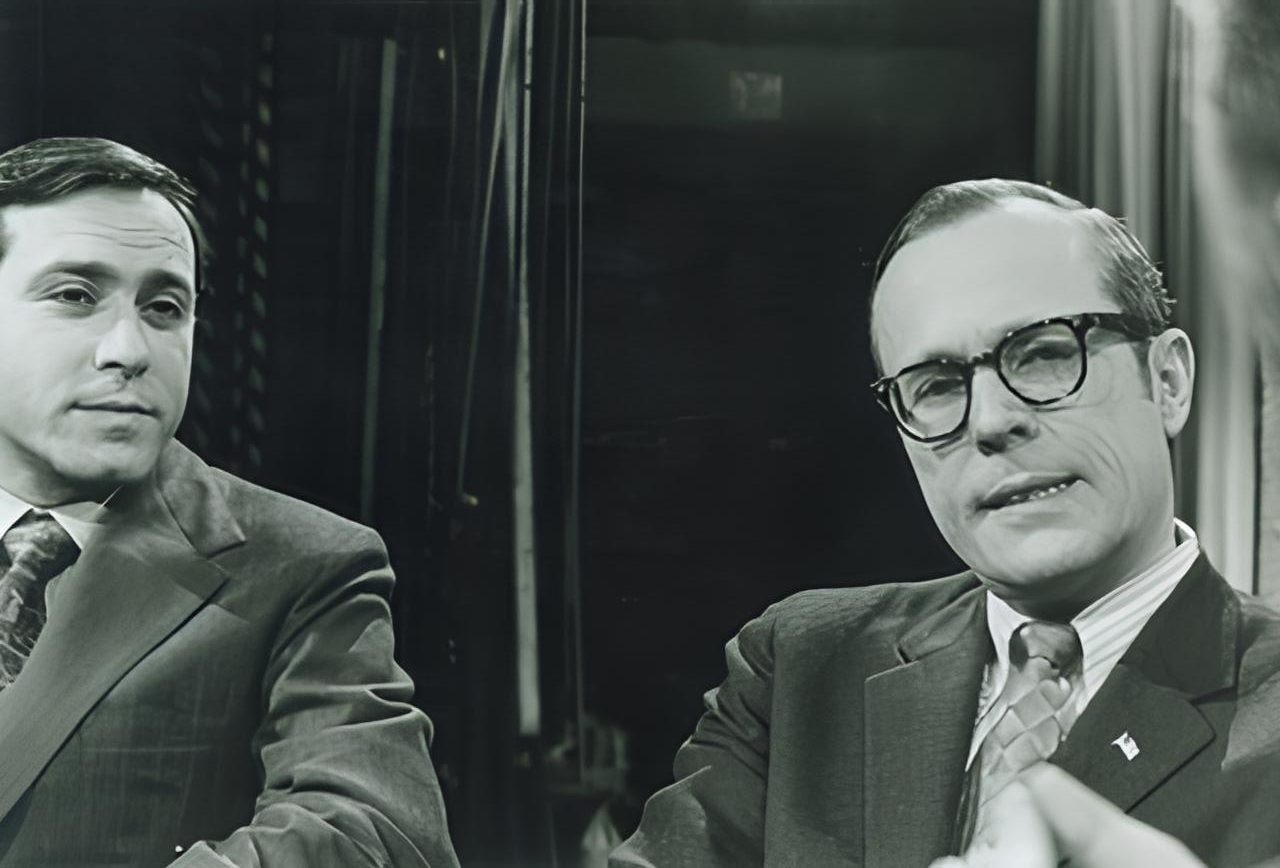
“Bill Rusher is every bit as vital to National Review as I am,” William F. Buckley informed the audience at the magazine’s 20th anniversary dinner in 1975. “Tonight he has been trenchant, which he always is; and diplomatic, which usually he isn’t. In contrast to his generous performance tonight, at National Review he exhibits no respect for me whatever; and that is very good for me, and therefore for my beloved National Review.”
For three eventful decades, William Rusher was central to National Review’s stellar success. But misconceptions arise easily about journals, as they do about people. An important one about NR and Rusher now needs correction—due especially to Buckley: The Life and the Revolution That Changed America, the long-awaited biography by Sam Tanenhaus, who was formerly the New York Times books editor. Its flaws are explained in the many reviews that have run in conservative outlets in recent months. But at least one—an injustice not to William F. Buckley Jr., but to Rusher and others—has received less attention: neglect of the vital teamwork and crucial disagreements at National Review.
Because it barely analyzes the magazine that was central to Buckley’s status on the right, Rusher—the publisher and Buckley’s indispensable NR and political partner from 1957 through 1988—is only a fleeting presence in this biography. Readers will have to look elsewhere to learn much about his forceful personality, political sophistication, selfless focus on the conservative cause, formidable intellect, and outspoken voice. All contributed greatly to the historic enterprise that was National Review.
Conservatives and others have sometimes identified NR too exclusively with its founder and editor, Buckley, but may not grasp fully that even this small enterprise, blessed with such a brilliant, luminous guiding spirit as Buckley was, nonetheless, a team effort. Buckley couldn’t spend all his time at National Review and also keep up a life in overdrive.
Both National Review’s distinctive style and its political and intellectual leadership were important not just to Buckley’s success, but also to the fortunes of the conservative movement. To understand either of those themes, literary or more politically practical, a reader must grasp the choices facing the NR top command over the years—choices with repercussions in conservative politics.
A Literary Thing, or Starting a Movement?
It has been widely assumed that Buckley was more intently focused on movement conservatism than he initially (or perhaps ever) was. Rusher remarked in an interview for my book If Not Us, Who? William Rusher, National Review, and the Conservative Movement, that, to Buckley, conservatism’s thin political presence around 1960 was “not all that undesirable a situation.” Buckley was “a literary man … doing a literary thing,” Rusher explained. “He didn’t have, I’d say at some level knew he didn’t have, a lot of political instincts—and therefore, starting a political movement was not really what he was about. It was very much what I was about.” That characterization of Buckley in this period might be doubted and challenged. But the accuracy of Rusher’s self-characterization is certain. In these formative years and later, Rusher pushed Buckley to make NR as politically activist in orientation as possible—without sacrificing polish, sophistication, or intellectual quality—and to recognize itself as holding an urgent leadership responsibility among conservatives.
Rusher’s value-added at National Review included his extensive knowledge of fellow activists who were unknown to his NR colleagues. And from his experience with the Young Republican National Federation, he knew a thing or two about organizational infighting. Rusher also brought a consistent commitment to evaluating the magazine’s content practically, through the prism of its political effect among those who read it. All this resulted from and reinforced Rusher’s concentration on the political arena—an arena often not at the forefront of his fellow intellectuals’ attention.
“Rusher has this special advantage,” L. Brent Bozell Jr., another major movement conservative and NR presence, told a friend of Senator Barry Goldwater’s in 1962, “that among young men with unmovable conservative convictions who are presently active in politics, he is better acquainted than any man in the country.” Priscilla Buckley, whose three decades as managing editor overlapped closely with Rusher’s thirty-one years as publisher, recalled to me: “Bill [Rusher] knew a great deal more about the insides of politics than most of the rest of us did, and it was much more important to him.” He “added a tremendous amount of political sophistication” to his colleagues’ analysis of “what was going on” in the country because he kept in close touch with political events and the people behind them.
Rusher was comfortable with, and had an ability to enjoy, unceasing political conflict. Jeff Bell, who worked at NR in the early 1960s and became a prominent political consultant on the right, shared a closely related key point about him. Distinguishing between the smaller ambition of merely wanting conservatives to influence the culture, and the larger one aiming at political dominance, Bell said appreciatively of Rusher: “He felt you had to try to win.”
A key moment in making National Review a more distinct political player came in 1960, when Buckley agreed with Rusher’s recommendation that it not endorse Richard Nixon for president in his tight race with John F. Kennedy. The senior editor who had the greatest influence on Buckley over the years, James Burnham, urged that National Review endorse Nixon. His main reason: nearly every force the magazine opposed politically as “its primary targets”—including the dangerous “appeasers” in the Cold War—was backing Kennedy. To “declare publicly against them” in the election, as it should, the magazine simply had to endorse the Democratic candidate’s—and thus their—opponent. Rusher, aligned with the more militant senior editor Frank Meyer, urged against support for the vice president. He did so partly because NR would, he said, have more influence in a Nixon administration if it had withheld an endorsement. Similarly, Rusher suggested that NR’s claim to seriousness in its rejection of the Eisenhower administration’s passivity toward communism and of its moderate Republicanism—a rejection central to what we would now call the magazine’s “brand,” since its founding five years earlier—would suffer if it ended up endorsing Nixon. After hearing both sides, Buckley told Burnham NR would not endorse the moderate Republican nominee. A Nixon endorsement might well make the hardline stances it was known for appear “unintelligible” to readers. In addition, Rusher made “a very good case … for suggesting that we actually increase our leverage on events by failing to join the parade.”
At the same time, though, a difference in journalistic judgment always complicated Rusher’s ability to be fully heard at NR. As Burnham observed to Buckley in these years: “Priscilla and I take a more professional point of view toward NR,” believing it should simply be “the best magazine in the world,” albeit with a “general (not too sharply defined) conservative and anti-communist point of view.” Meyer and Rusher “also want a good magazine … but … first of all want a crusade, a political party and a kind of ersatz church,” with NR either being those things itself or “organically … a part” of all three. National Review should “have a certain aloofness” from any of these, “even if it altogether agreed with them.” Whether Burnham’s description of the Rusher and Meyer vision was entirely fair or not, it identified a great difference between their vision and his (which tended also to be Buckley’s). One place where this difference mattered was in the recurring question, with each new job opening or notably promising new talent, of which writers should be brought onto the magazine. Rusher found it irritating—he said it was “a bad habit” of Buckley’s—that young writers were often hired without Buckley knowing their political orientation. As Priscilla later noted in her delightful short memoir, Living It Up at National Review: “What was most important to Bill [Buckley]” as its editor “was that the writing be distinguished. It seemed to him more important that a writer write beautiful prose than … be a movement conservative.”
Rusher’s Focus and Advocacy
Firm maintenance of an ideologically conservative, movement-oriented identity, plus a constant aim to augment National Review’s influence in politics, were Rusher’s main objectives when he brought his eloquent voice to its internal deliberations. His great ally at the magazine, Meyer—about whom an interesting, well-researched new biography, by Daniel Flynn, published this year—pursued a closely related goal: to maintain a clear distance between what an NR opening statement in 1955 had called the morally inadequate, implicitly establishmentarian “well-fed Right” and the “radical conservatives” whom the infant journal intended to champion. Meyer’s son John recalled to me that his father’s struggle at NR was, especially, “to prevent it from becoming what he called ‘the right wing of the establishment’ ”—and “keep it from basking in the recognition of: ‘Oh, you’re the intelligent conservatives,’ ”—since he thought Buckley was “prone to that tendency” due to his increasing connections in high society. After the magazine’s first five years or so, Meyer felt he was constantly struggling against such an attitude. It was “an ongoing battle that he expected to be fighting forever.”
Yet any such currents at NR were balanced, if not wholly stemmed, by Meyer’s and Rusher’s relentless internal advocacy, along with a development occurring among right-wing activists. This development had two sides that fed on each other: the growth of a zealously political yet also intellectual group called Young Americans for Freedom, founded by Buckley, Rusher, and others in 1960, plus the initially behind-the-scenes campaign to push Goldwater to run for president and win the 1964 nomination (an effort of which Rusher was likewise a co-founder).
In advising Buckley and other colleagues what the magazine should cover, what it should emphasize, and how, Rusher was guided by his focus on its reputation and credibility among conservatives and on its ability to help and influence them. To strongly affect the conservative world, which he—like Buckley and the other editors—believed needed its good influence, NR must, he said, “retain a substantial following among responsible conservatives.” And responsible—serious and mature—though they were, it was nonetheless possible for National Review to alienate them by, for instance, keeping too distant from Goldwater on the grounds that he might not be an ideal spokesman or candidate for the right. Rusher’s concern about this had a good basis: Burnham, Buckley, and another major NR figure, Willmoore Kendall, all believed or—in Buckley’s case—feared that Goldwater was not ideal.
YAF loved Goldwater; and NR, Rusher suggested to his colleagues, needed its full confidence. As he wrote to Bozell after the first national YAF rally, in New York in early 1961:
“As I watched and listened to it, I was profoundly glad that Bill [Buckley] was up on that stage too, and that he was identified in the minds of the audience as a friend of the cause they believe Goldwater to be championing—rather than … editor of an impossibly perfectionist journal which had just brushed Goldwater from its sterile toga.”
That moment and comparable ones figured significantly in Buckley’s, the magazine’s, and the movement’s history. But the underlying challenge remained: Rusher differed from Buckley and some of the others on exactly what NR should be. Buckley seems to have continued to believe in having an outstanding magazine first, an actively political product second. Despite this preference or tendency of Buckley’s, Rusher long served to remind the NR leadership that his political knowledge, and the movement’s need for inspiration and guidance, should influence their decisions more often than they might think. Thanks to his widely conceded knowledge and his wit, good manners, and sincerity, he could say not-always-welcome things to them. Thanks to their political seriousness and intellectual honesty, they could heed his perspective. And for Buckley’s “beloved National Review” and all of us, that was a very good thing indeed.